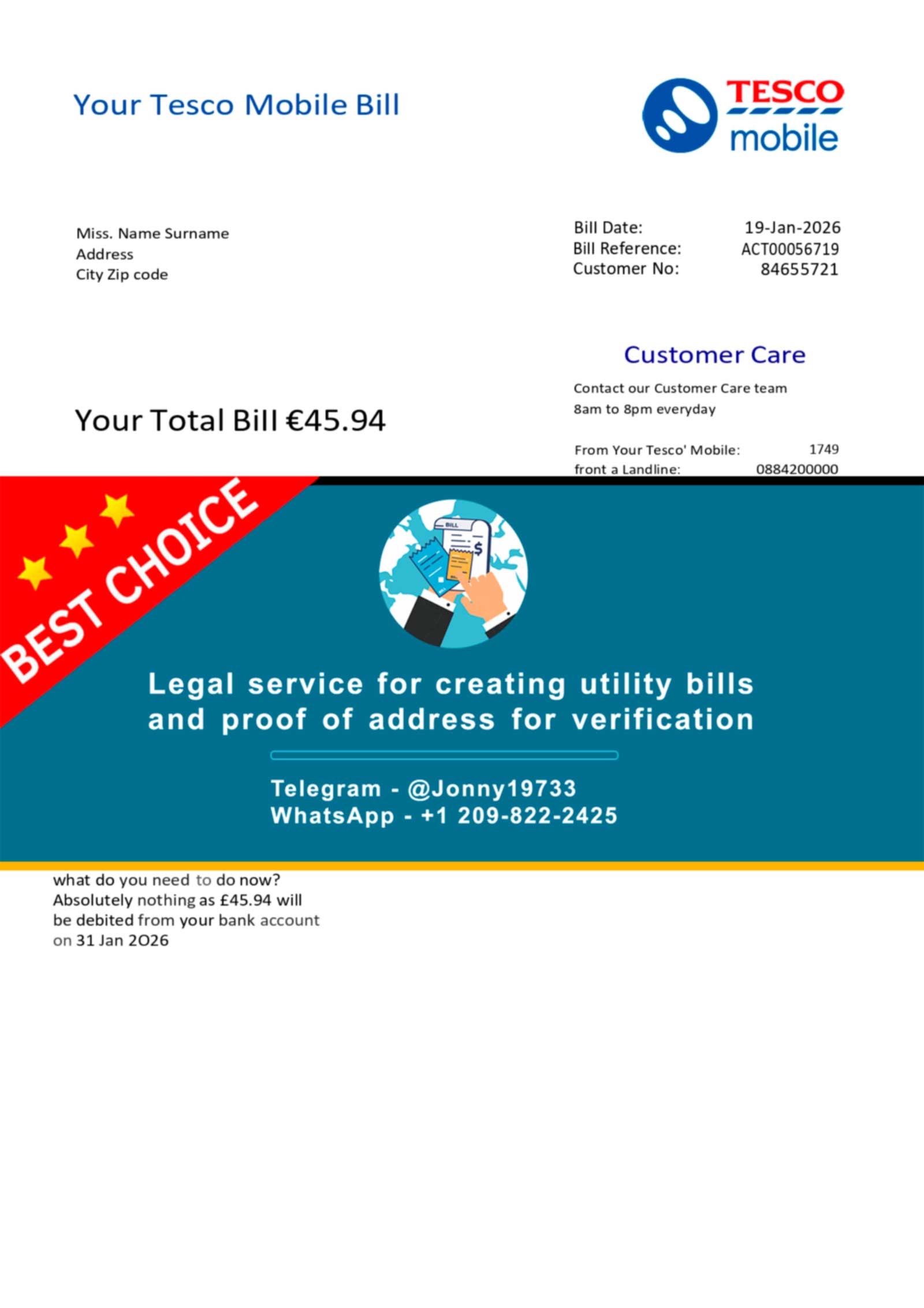
Phone bills in the United Kingdom are commonly used as periodic account statements that summarise mobile or fixed-line service usage over a defined billing cycle. These documents are typically issued on a regular basis and present a consolidated view of charges, usage activity, and account references in a structured layout. While the purpose of a phone bill is broadly consistent across the country, the visual presentation, terminology, and ordering of sections can vary depending on service arrangements, billing platforms, and regional practices.
This page provides a country-level reference to how phone bills in the United Kingdom are commonly structured from a document layout and formatting perspective. It is intended as an educational overview of typical patterns rather than official documentation. Individual phone bill formats may differ significantly across providers, plans, and regions, and no single layout should be considered definitive.
Typical Layout Structure of Phone Bills in the United Kingdom
Most phone bills issued in the United Kingdom follow a multi-section layout designed to separate account identification, usage information, and financial totals into clearly defined areas. Information is usually arranged in a top-down hierarchy that allows readers to locate key details without reviewing the entire document.
A common structural pattern often includes a header section containing account references and billing period information, followed by one or more central sections detailing usage and charges. The document typically concludes with a summary area that consolidates totals and payment-related references. This layered approach reflects standard document design practices used across many recurring service statements and supports quick orientation.
Common Information Displayed on Phone Bills
While the exact data fields shown on a phone bill can vary, many UK phone bills display a consistent set of informational elements presented in a structured manner. These elements are usually grouped to distinguish between identification details, usage activity, and financial calculations.
Information that may be shown includes account or customer references, the billing period covered by the statement, and summaries of voice, messaging, or data usage. Charges are often itemised to show recurring fees and usage-based costs separately. Tax-related amounts may also be displayed where applicable, typically as part of the overall charge breakdown rather than as standalone sections. The inclusion, naming, and placement of these elements can differ depending on billing systems and service configurations.
Country-Specific Formatting Characteristics
Phone bills in the United Kingdom are generally presented in English and use local conventions for dates, currency, and numeric formatting. Billing periods are commonly shown using day–month ordering, and monetary values are displayed in pounds sterling. Documents often follow a clean, structured visual style that prioritises readability, with clear section headings and aligned columns.
Some layouts use tables to organise usage details, while others rely on grouped text blocks with visual separators. These formatting choices reflect administrative preferences and platform capabilities rather than regulatory requirements, and they can evolve over time as billing systems change.
Visual Readability and Document Structure
Clarity and visual organisation are central considerations in the layout of UK phone bills. Designers typically aim to present complex usage and charge information in a way that can be quickly understood without extensive explanation. Headings, spacing, and alignment are commonly used to guide the reader through the document and to distinguish between different categories of information.
This emphasis on readability supports general comprehension of the statement’s contents but does not imply uniformity across all phone bills. Variations in layout density, typography, and section order are common, particularly between different service types and billing platforms.
PDF and Image Formats Commonly Used
Phone bills in the United Kingdom are frequently delivered as digital documents, often in PDF format, although image-based representations may also be used in certain contexts. These formats allow for consistent visual presentation across devices and preserve layout integrity when viewed or printed.
From a structural perspective, digital formats typically mirror the same sectioning and hierarchy found in printed statements. Differences may arise in how interactive elements, such as expandable sections or hyperlinks, are incorporated, but the underlying layout logic remains comparable.
How Phone Bill Formats May Differ Across Regions Within the United Kingdom
Although phone billing practices are broadly consistent at a national level, layout and presentation details can vary across regions within the United Kingdom. Differences may stem from regional service arrangements, administrative workflows, or platform-specific configurations rather than geographic regulation.
These variations can affect section ordering, terminology, or the level of detail shown in usage summaries. For users seeking more localised references, regional pages provide additional context on how phone bill layouts may appear in specific areas.
Explore Regional Phone Bill Formats in the United Kingdom
For more detailed, location-specific layout references, you can explore regional phone bill format pages within the United Kingdom. These pages focus on structural patterns observed at a regional level and build on the country-wide overview provided here.
Disclaimer
This page provides illustrative references to common phone bill layout patterns in the United Kingdom for educational and informational purposes only. The materials shown or described are not official utility bills and are not affiliated with any phone service provider. Acceptance, verification, or approval of any document format is not guaranteed. All examples and explanations are high-level format references intended to demonstrate typical document structure rather than authoritative or provider-specific guidance.
For a broader perspective, you may also refer to the global overview of phone billing documents available in the
General phone bill format references.